
KAWTAR AIT EL HAJ
Innovative Health Financing Solutions in Sub-Saharan Africa
Innovative Health Financing Solutions in Sub-Saharan Africa
Access to quality healthcare remains a major challenge in sub-Saharan Africa, with financing a central issue (as detailed in one of our previous articles). Traditional financing methods are often insufficient to meet the population’s diverse and evolving health needs, particularly in the current geopolitical and economic context.
It is time for our countries to adopt and/or further develop emerging innovative solutions that offer renewed hope and pathways towards sustainable health financing. Here are a few examples:
1. Mobile Payment Systems for Healthcare:
Mobile payment systems for healthcare leverage the widespread use of mobile phones in the region. Platforms such as M-Pesa in Kenya have revolutionised how people pay for healthcare, making transactions simpler, faster and more secure. By integrating health insurance payments and microloans, these systems expand access to health services for millions of people.
2. Community-Based Health Insurance (AMC):
Community-based health insurance schemes pool resources at the community level to provide affordable healthcare. These schemes are particularly effective in rural areas where access to formal insurance is limited. By fostering a sense of ownership and solidarity, AMC schemes ensure that even the most vulnerable have access to essential health services.
3. Public-Private Partnerships (PPP):
Public-private partnerships combine government resources with private-sector efficiency to improve healthcare infrastructure and service delivery. PPPs have been essential in building hospitals, supplying medical equipment and training healthcare professionals, thereby strengthening the overall capacity of the health system.
4. Innovative Financing Mechanisms:
Innovative financing mechanisms such as social impact bonds and health impact funds attract investment by linking financial returns to health outcomes. These mechanisms encourage investment in preventive care and healthcare innovations, ensuring financing that is both effective and sustainable.
The Insurtech/HealthTech startup Susu, founded by French-Beninese entrepreneur Bola Bardet, is an example of impact fundraising. Susu is a digital health platform that enables members of the African diaspora to cover healthcare for their loved ones living on the continent.
5. Telemedicine:
Telemedicine removes geographical barriers, enabling patients in remote areas to access specialist care. By reducing the need for physical infrastructure and enabling remote diagnosis, telemedicine offers a cost-effective solution that improves healthcare accessibility and quality.
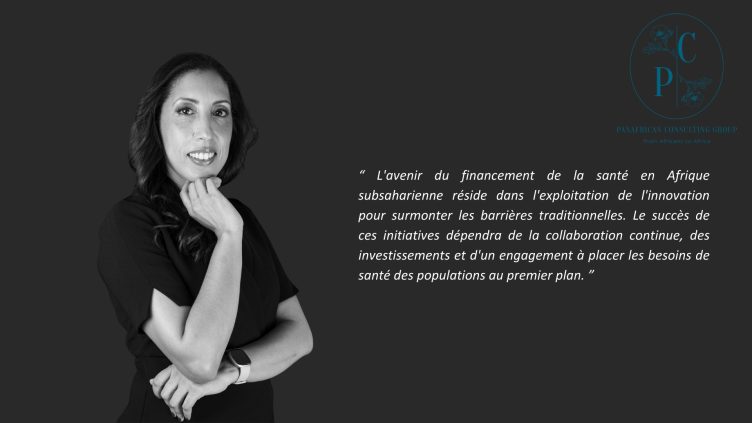
The future of health financing in sub-Saharan Africa lies in harnessing innovation to overcome traditional barriers. The success of these initiatives will depend on continued collaboration, investment and a commitment to putting people’s health needs first.
#HealthFinancing #Innovation #SubSaharanAfrica #HealthcareSolutions #PublicHealth
Save my name, email and website in this browser for the next time I comment.
PANAFRICAN ADVISORY
Let’s prepare your next decision.
Growth, investment or partnership: start with the realities of your market.