
KAWTAR AIT EL HAJ
Financing Africa’s energy transition without falling into the debt trap
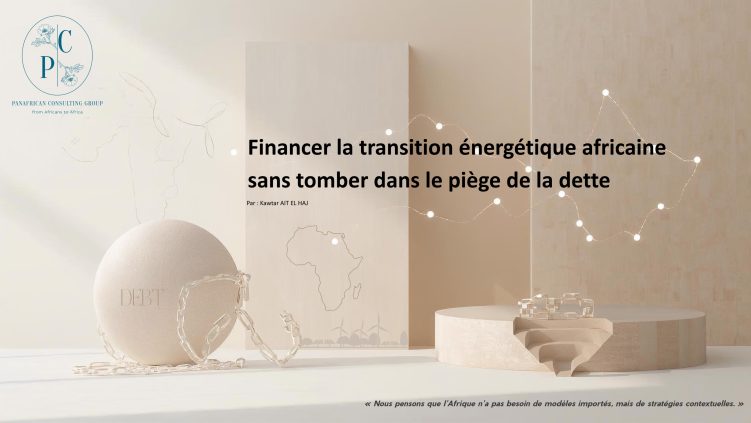
Financing Africa’s energy transition without falling into the debt trap
Africa has no shortage of ambition when it comes to renewable energy. The continent holds 60% of the world’s best solar resources, vast wind corridors from Morocco to Egypt, and largely untapped hydropower potential in West Africa. What is missing is not sunshine or wind, but financing models suited to African realities.
Too often, the question is framed as: “How can Africa attract the same financial flows as Europe or Asia?” But this question misses the point. The expansion of renewables in Europe relied heavily on subsidies, sovereign guarantees and public debt. This created capacity, but also fragility. When subsidies were withdrawn, many projects collapsed, leaving stranded assets and over-indebted economies. Africa cannot afford to follow the same path.
The financing gap in West and North Africa
Countries such as Morocco, Egypt, Senegal and Nigeria have set ambitious targets. Morocco is at the forefront of solar and wind power, Egypt is making rapid progress on green hydrogen, while Senegal and Nigeria are investing in gas-to-power as a transitional energy source. Yet financing is concentrated on large independent power producers (IPPs), supported by international funders.
The problem is structural:
SMEs, cooperatives and community projects have virtually no access to climate finance. Currency risk makes returns uncertain and increases borrowing costs. Funding cycles favour short-term pilot projects over sustainable industrial strategies. Local financial markets remain shallow, with pension funds and banks reluctant to commit without guarantees.
SMEs, cooperatives and community projects have virtually no access to climate finance.
Currency risk makes returns uncertain and increases borrowing costs.
Funding cycles favour short-term pilot projects over sustainable industrial strategies.
Local financial markets remain shallow, with pension funds and banks reluctant to commit without guarantees.
If nothing changes, the transition risks amounting to “large international developers building for export”, while local economies remain under-equipped and communities lack adequate energy supplies.
Lessons from Europe
Europe’s experience offers many warnings. In Spain, Italy and Germany, feed-in tariffs triggered a rush into solar and wind power. But when governments cut subsidies, bankruptcies multiplied. Investors lost confidence, and citizens paid the bill.
Two key lessons for Africa:
Avoid excessive reliance on public subsidies or sovereign debt. Balance export ambitions with domestic needs.
Avoid excessive reliance on public subsidies or sovereign debt.
Balance export ambitions with domestic needs.
What needs to change
An effective African model must combine innovation with pragmatism:
Blended finance and guarantees to reduce risk and attract private investors. Diaspora green bonds to channel a share of the $95 billion sent in remittances each year. Dedicated mechanisms for SMEs and cooperatives, with simplified procedures and regional platforms. Currency hedging instruments to lower the cost of capital. Development of green capital markets to enable pension funds and insurers to invest in certified projects.
Blended finance and guarantees to reduce risk and attract private investors.
Diaspora green bonds to channel a share of the $95 billion sent in remittances each year.
Dedicated mechanisms for SMEs and cooperatives, with simplified procedures and regional platforms.
Currency hedging instruments to lower the cost of capital.
Development of green capital markets to enable pension funds and insurers to invest in certified projects.
Avoiding the debt trap
Today, several African countries spend more on debt servicing than on health or education. Financing the transition solely through loans is unsustainable. Africa must demand financing models that combine grants, concessional funding, guarantees and private capital, and that strengthen local industries rather than make them dependent.
Conclusion
Africa’s energy transition will depend less on installed megawatts than on the financing models adopted. If Africa follows the European model—excessive subsidies, massive debt and fragility—it will inherit the same vulnerabilities. But if it innovates in financing, it can build an inclusive, resilient and transformative transition.
#ClimateFinance #GreenInvestment #EnergyTransition #ImpactInvesting #SustainableFinance #PrivateCapital #AfricaInvestments #RenewableFinance #DiasporaBonds #BlendedFinance
Save my name, email and website in this browser for the next time I comment.
PANAFRICAN ADVISORY
Let’s prepare your next decision.
Growth, investment or partnership: start with the realities of your market.